Swimming in unused beauty products that cost too much? Spending your shower time digging through bottles of products, many of which seem to do the same thing? Decide what you really need, and next time you’re shopping, keep your list short!

Fellow advocates of sustainable living often recommend choosing personal care products with a simpler ingredient list. Many companies offer “natural” products. I could give you dozens of recipes to make your own shampoos, conditioners, soaps, and lotions.
At the end of the day, though, whether filled with name-brand, all-natural, or homemade products, a cluttered shower is neither visually appealing nor very efficient.
I asked other simple living and green living bloggers, “If you could have just 3 beauty or health products in your shower, what would remain?”, and compiled the overall results:
1. shampoo
2. soap
3. nothing!
I was surprised, but most people either already use only soap and shampoo (forgoing conditioner and shaving with either the soap or shampoo), or decided that once they got rid of a bunch of stuff, they really didn't need a 3rd item. I'll share about my own shower in a future post.
Popular brands include Korres, Burt's Bees, and your local Farmer's Market sellers!
 , and your local
...and you?
What about all the other stuff? Cremes, conditioners, gels, butters, salts, cleansers, and so on? Why do we have them; are they necessary? What are your 3-to-keep's?
Busy people + the need for storage can all too easily equal clutter. Here's the good, the bad, and the how-to make it better from my own desk drawer experience.
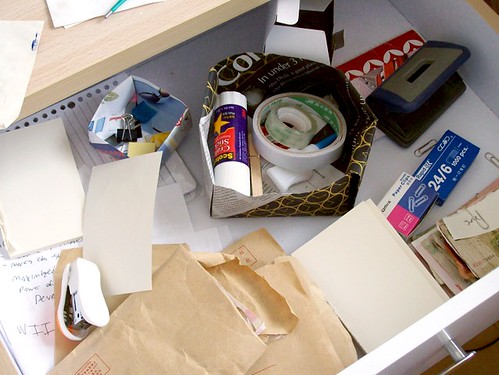
Home from vacation, it didn’t take too long to discover the dreaded desk drawer that’d become a cluttered toss-all pile weeks before we left. Looks like a home organization job to me!
I took the picture above for memory's sake before digging in.
Though not as visually frightening as some, it wasn’t working out; we spent too much time with a hand in that drawer.
The good:
Organizers (the little boxes) within organizers (the drawer) work well. Most notecards are neatly stacked. Money is either in envelopes, or paper-clipped with labels.
The bad:
Some items (stapler) are on top of unrelated items (envelopes). Loose items (paper clips) have no home. A pile of used paper meant for reuse keeps growing under the envelopes because it’s easier to get to the (store-bought, i.e. not free) notecards. The larger box is made of newspaper, so its sides don’t hold up very well.
The desk-drawer clutter $0.00 solution:
The how-to:
First, I made some decisions: “Will I really ever use this?” Though I may, someday, want a 6.75x4” piece of paper, I’ll likely be fine with just one size. I took the largest paper and divided it in 4. Just fold and tear - no need for smooth, perfectly straight edges. I took all the other paper and tore them to the same size. Smaller scraps will become recycled paper later. I clipped the new notes together and decided not to keep more than will fit in the clip - excess will be recycled too. We won’t need to buy notecards anymore, either (frugal bonus!)
Second, I got rid of loose items. I put some paperclips and staples in the smaller box. Large items go in the new, sturdier large paper box.
Third, I combined rarely-used items out of the way. See the white box in the corner? The lid was always cumbersome when I just wanted to grab or put away something, so I tucked it and the flaps inside the box. Since I have staples and paper clips out (second step), I won’t often need their boxes, so they’re tucked away back there, too. Several cards that previously floated around the room are now stuck upright in that box.
Fourth, I oriented items so nothing important overlaps. It turns out the envelopes fit better longways, for example.
Fifth and lastly, I did a visual check. Because the colorful collections of items were all on the right side of the drawer, I switched the new notepad paper with the newspaper box. Not a big deal, but it looks a little better this way.
That’s it!
...and you?
What’s your $0 organization solution that saves you bits of your precious time here and there, time that adds up? Comment for a chance to have your tip featured here on Simple Makes! Or, reorganize your desk drawer and post the before-and-after at our flickr group.

What craft books are the best to keep around? When do you know you have enough? A confession, a solution, and some recommendations to help you simplify your selection of crafting how-to books.

A Solution
Here are a few useful tips I’ve found to keep my book pile under control.
1. Keep the best, and only the best - I keep comprehensive books that I refer to often instead of those which just have one pattern I like. The same “if you haven’t enjoyed it in the past year, let someone else enjoy it” rule applies here.
2. Don’t keep more than you can store - If your books no longer fit on their designated shelf, you may need to get rid of excess books, not buy more shelving!
3. Borrow & share - Use libraries, your friends, and online organizations like Bookcrossing. This way, you rotate fresh ideas in and out of your library, keeping only the most useful and passing along those that someone else can better use.
Recommendations
As promised, I’d like to share recommendations from my bookshelf and other crafters'. With just these few, I (or whomever) have all the information I need for almost every project I encounter:
#1 for hand embroidery: Complete Guide to Embroidery Stitches
#1 for sewing: Sew Everything Workshop


#1 for jewelry: All Wired Up
#1 for soapmaking: The Everything Soapmaking Book

...and you?
What craft book could you not do without? Comment with the type of craft and your book recommendation. You can also take a picture of your craft books, organized or chaotic, and post them on the Simple Makes flickr group!

 Posts


